
After several years of our bird feeders empty of seeds, this spring we once again have seeds in our feeders. We have feeders that support sunflower seeds and feeders with the small Niger seeds. Having both hopefully means we will get several varieties of birds. And along with the seed feeders, we have a barrel that has a black rubber pan that has water in it. and in the middle is a flat wooden platform, with a short can nailed to it with jelly in it. The jelly is for the orioles, the water acts like a moat for keeping the ants away from the jelly. We prefer to see the beautiful oriole birds getting the jelly instead of the tiny ants that invade if given the chance.
While we have seeds in abundance for the little yellow gold finches, we have had almost no takers. And that is sad. They are such bright spots of cheer on any day, especially cloudy ones. We miss them. The only birds taking advantage of those small seeds are the chipping sparrows. The little chipping sparrow is my favorite sparrow. I love to hear their “chipping.” I love their cute little caps. I am reminded that God loves the sparrows and even one missing makes Him sad. “God sees the sparrow” is a comforting phrase I read in Matthew 10:29-31, where Jesus teaches that if God observes even tiny, inexpensive sparrows—noting when they fall—He cares much more for people and me, and we are far more valuable. This promise shows me that God’s personal attention to detail is unwavering. Not one sparrow falls to the ground apart from the Father’s will or knowledge. And because God watches over sparrows, I can trust Him to care for me, knowing I’m worth “more than many sparrows”. This message is designed to get rid of my anxiety and fear, reminding me and others that we are never forgotten by God.
“His Eye Is on the Sparrow” is a famous hymn based on this passage and should reinforce the message that if God watches over birds, then He is watching over individuals, too. We have no excuse for being discouraged.
Why should I feel discouraged? Why should the shadows come? Why should my heart be lonely And long for heav’n and home, When Jesus is my portion?
My constant Friend is He: His eye is on the sparrow, And I know He watches me; His eye is on the sparrow, And I know He watches me.
I sing because I’m happy— I sing because I’m free— For His eye is on the sparrow, And I know He watches me.
Let not your heart be troubled. His tender word I hear, And resting on His goodness, I lose my doubt and fear. Though by the path He leadeth, But one step I may see: His eye is on the sparrow, And I know He watches me.
Whenever I am tempted, Whenever clouds arise, When songs give place to sighing, When hope within me dies, I draw the closer to Him; From care He sets me free: His eye is on the sparrow, And I know He watches me; His eye is on the sparrow, And I know He watches me. I sing because I’m happy— I sing because I’m free— For His eye is on the sparrow, And I know He watches me.
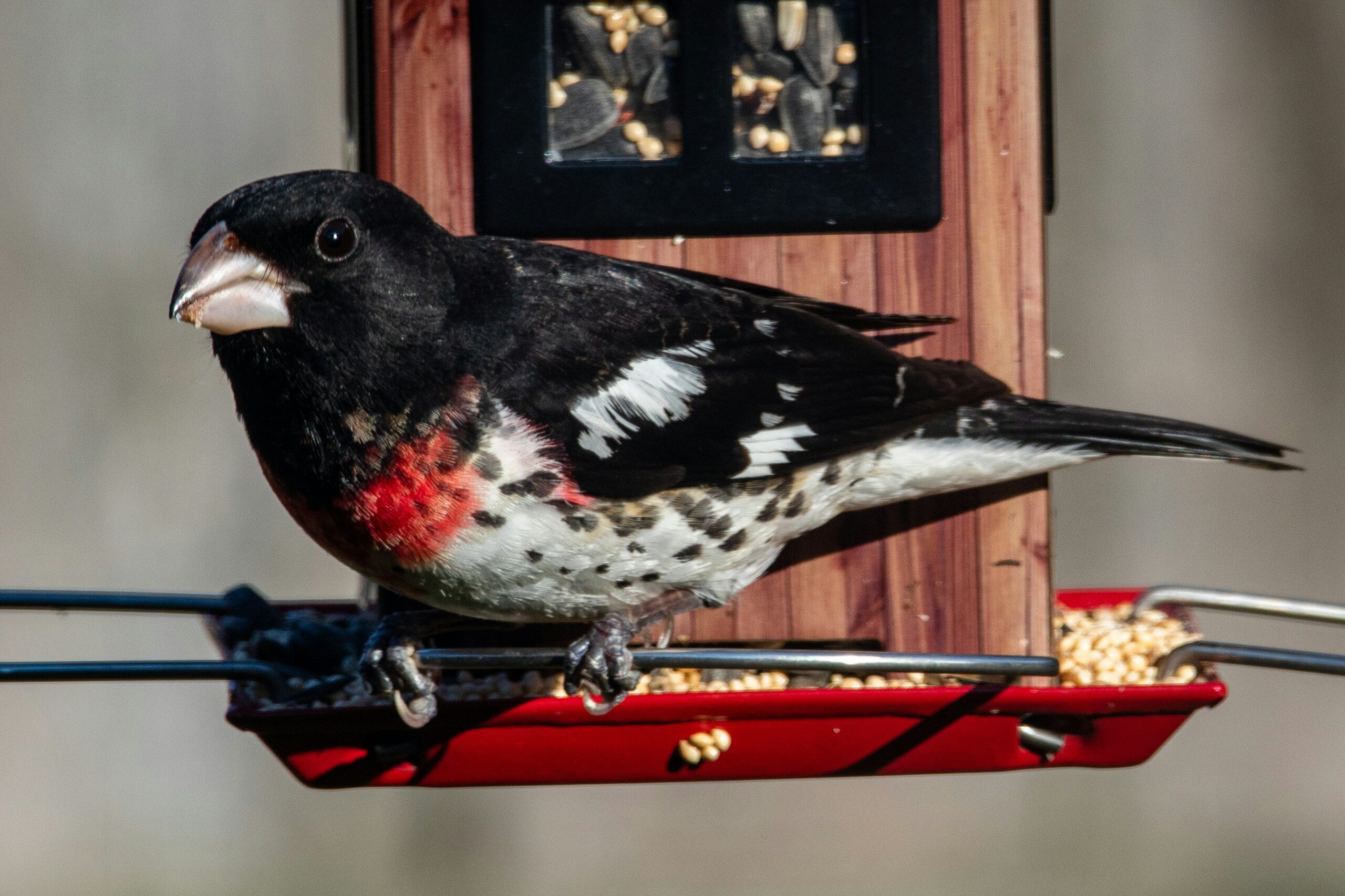
The seed feeders were filled and hung just at the right time! The grosbeaks are back! Seeing them makes us so happy! They are back on time! The return of the Rose breasted Grosbeak is a thoughtful reminder of nature’s faithfulness and beauty and can signal that spring migration has brought a “gospel reminder” for us to our backyards. With its striking black-and-white plumage contrasted by a vivid rose-red neck bandanna, the male grosbeak serves as a living illustration of God’s artistry. What a beautiful little bird, though God seems to have decided that only the male birds should be beautiful. The ladies are rather plain looking in comparison. The severe contrast of the black and white on the grosbeak, along with its bright rose-red chest, can remind us of the wordless book of spiritual truths—moving from darkness to light and the redemptive hope often associated with the color of its breast. It is a living, walking reminder of the beauty that follows the “storms” of life. These birds are known to sing even while building their nests and raising young. The grosbeak should teach us to maintain a song of joy and praise in our own daily work. Its song, described as a “mellower” version of a robin’s, suggests a life lived with deep, heartfelt expression rather than just daily routine. The return of the grosbeak can call us to pause and reflect on Jesus’ lesson to “look at the birds of the air”. They return without worry, and their presence prompts us to trust that our heavenly Father provides for all our needs. Their return is reliable and on time each spring, yet special, a part of spring that calls us to stop, appreciate the simple beautiful moments, and see God in the details. Seeing a male Rose-breasted Grosbeak first appear, often brings a moment of “holy awe,” is a reminder that beauty is worth waiting for and that we are watched out for by our great “Care Giver.”
Where I often can be found sitting, I have a great view of the feeder the Grosbeaks like to visit, filled with black sunflower seeds and some white safflower seed. We have at least 2 pairs of the grosbeaks and one teenager, downys, nuthatches, bluejays, house finches, other sparrows, and a red headed woodpecker. Some get along with each other, the others, not so much. And when the Grosbeaks are present, the other birds will often leave. They mostly leave because the bossy selfish, every man for himself grosbeaks peck at them, and the grosbeaks have called the other birds naughty bird names, circled the feeder “screaming” at the other birds until they have made it so uncomfortable that the others give up and leave to await their turn when no grosbeak is around. I have learned that it is very common for American Grosbeaks (specifically the Rose–breasted Grosbeak that we see) to exhibit aggressive, territorial behavior, often taking over feeders, chasing away other species, and even driving away females. But I have also seen the females drive other birds away. Males are highly territorial and defensive of food sources during migration or while establishing breeding territories. Males try to dominate the feeder, frequently making females and other birds wait for their turn. My observations and other research indicates that the markings on the male (white rump/flanks) can stimulate aggression in other males, causing them to fight each other besides trying to run off their own wives and the other species. During migration (roughly mid-April to mid-May), they consume huge amounts of energy, often from sunflower or safflower seeds, causing them to “park” at feeders and bully others. Some bird observers see that while the males are aggressive, they often operate within a social hierarchy where only larger birds (like Blue Jays) can make them move though I can say for sure they still try to make the bluejays move on! One bird is determined to ignore the selfish grosbeak. That is the nearly double in size Red headed Woodpecker. He or she mostly ignores the grosbeak and makes sure it gets its sunflower see, flies away to the top of our very tall yard light pole, shells and eats his treat and then is back for another. The woodpecker refuses to be intimidated. A good lesson for me—don’t be intimidated when you know you have the right as much as anyone else. God is stronger than the bullies.
Watching a Rose-breasted Grosbeak take over a bird feeder is a dramatic lesson in the natural world. These beautiful creatures—with their striking white, black, and rose markings—often become incredibly aggressive, acting as “bullies” by chasing away other birds and even their own mates. Yet, this behavior serves is a powerful mirror for our own lives, revealing several devotional truths: Even when the feeder is overflowing with sunflower seeds, the grosbeak acts as if there is not enough, behaving as if the food will disappear. This is sometimes called a “scarcity mindset.” How often do we, despite God’s promised abundance, hoard our time, resources, or affections out of fear that there won’t be enough for us? We act as if a blessing is a finite resource, driving others away to ensure our own spot. But in the words of another song: “When you are discouraged, thinking all is lost, count your many blessings, name them one by one, And it will surprise you what the Lord hath done. Count your blessings, name them one by one; Count your blessings, see what God hath done; Count your blessings, name them one by one; Count your many blessings, see what God hath done.” It seems to indicate that where we see one blessing, there are perhaps at least a thousand more! The male grosbeak often attacks his own species, driven by the instinct to own his territory. He tries to control his environment absolutely. But true peace isn’t found in controlling our circumstances, but in trusting the Creator who feeds “the birds of the air”. When we try to play “king of the feeder,” we lose the joy of the scenery and the companionship of other birds.
Because of the greediousness of one bird, you might find yourself wanting to put out an extra bowl of seeds just to accommodate the selfishness of one bird. This is a picture of God’s grace—He provides extra space and extra grace, even when our selfish hearts seek to claim everything for ourselves.
Lord, thank You for the beauty of Your creation, even the difficult parts. Cleanse me from the selfishness that drives others away. Help me to trust in Your abundance and to share the bounty of Your grace freely, rather than guarding it with a “grosbeak” heart.
“Do nothing from selfish ambition or conceit, but in humility count others better than yourselves.” Philippians 2:3. The true joy of the feeder is watching all of God’s creatures eat together. It has been said that the red patch on the rose-breasted grosbeak’s chest often represents a “bleeding heart” that symbolizes healing of old emotional wounds and family wounds. In the beauty of the combination of the colors of red and black and white, we can know that we have the hope of beauty in the healing of our emotional distresses and wounds. I am longing for the day when there will not be any need for healing from our distresses and wounds. The love of God will help us heal and center our hearts on the love instead of selfishness and greed. We can expect to have a higher power to guide us and to provide protection, comfort and support during our daily challenges.
Just as the birds are so hungry, let me be just as hungry for the Word!